
Liftgate Delivery: Costs and When You Need It
A practical guide to liftgate delivery: what drives the cost, when you actually need one, and how to avoid a failed delivery or a surprise fee.
What a Liftgate Actually Is, and Why It Matters
A liftgate is a powered platform mounted on the back of a delivery truck that lowers freight to ground level, and raises it back up, without a dock or a forklift. If you've ever watched a delivery truck pull up to a house or a small business with no loading dock in sight, and freight comes down smoothly on a hydraulic platform instead of getting muscled off the tailgate, that's a liftgate at work.
It sounds like a small detail. It isn't. Most freight in the 150 to 1,500 lb range, think appliances, gym equipment, pallets of retail stock, crated machinery, is built to be loaded and unloaded at a dock, where the truck bed lines up with a raised platform and a pallet jack can roll straight across. Take away the dock and you need another way to get that weight down safely. That's the entire reason liftgate service exists as its own line item on a freight quote.
Here's the part shippers miss: the liftgate isn't optional based on preference. It's determined by the receiving location. A residential address, a strip mall storefront, a construction site trailer, a small office without a dock, all of these need a liftgate by default, because there's no dock to substitute for one. Skip it on the booking and the driver shows up with no way to get a 400 lb crate off the truck without help that may not be there.
We cover this from our base in the Inland Empire out to Los Angeles and the surrounding region, and the pattern is consistent: the deliveries that fail at the door are almost always the ones where liftgate need wasn't confirmed before the truck left.
What Actually Drives the Cost of a Liftgate
There's no flat, published liftgate fee that applies everywhere, and that surprises a lot of first-time shippers. What you're charged reflects a handful of real variables, not a random markup:
- Weight and dimensions of the freight — a 150 lb box and a 1,200 lb crate both need a liftgate, but the truck, the platform capacity and the handling time differ.
- Delivery type — residential liftgate delivery typically costs more than commercial, because residential stops usually add narrower access, no staging area and often a scheduling appointment on top of the liftgate itself.
- Inside delivery or placement — a liftgate gets freight to ground level at the curb. If you also need it carried into a garage, a specific room or up a step, that's a separate accessorial, not included in the liftgate charge.
- Access difficulty — a gated community, a narrow alley, a rural driveway, or a building with no truck turnaround room all add time and sometimes require a smaller vehicle, which changes the rate.
This is exactly why we don't publish a generic liftgate rate on our site: two shipments at the same weight can price differently once you account for where the truck is actually going and what happens after the freight hits the ground. The honest way to get a real number is to send us the pickup and delivery addresses, the weight and dimensions, and whether the receiver needs inside placement. For a full breakdown of how these variables combine into a quote, see our piece on what a freight quote actually prices.
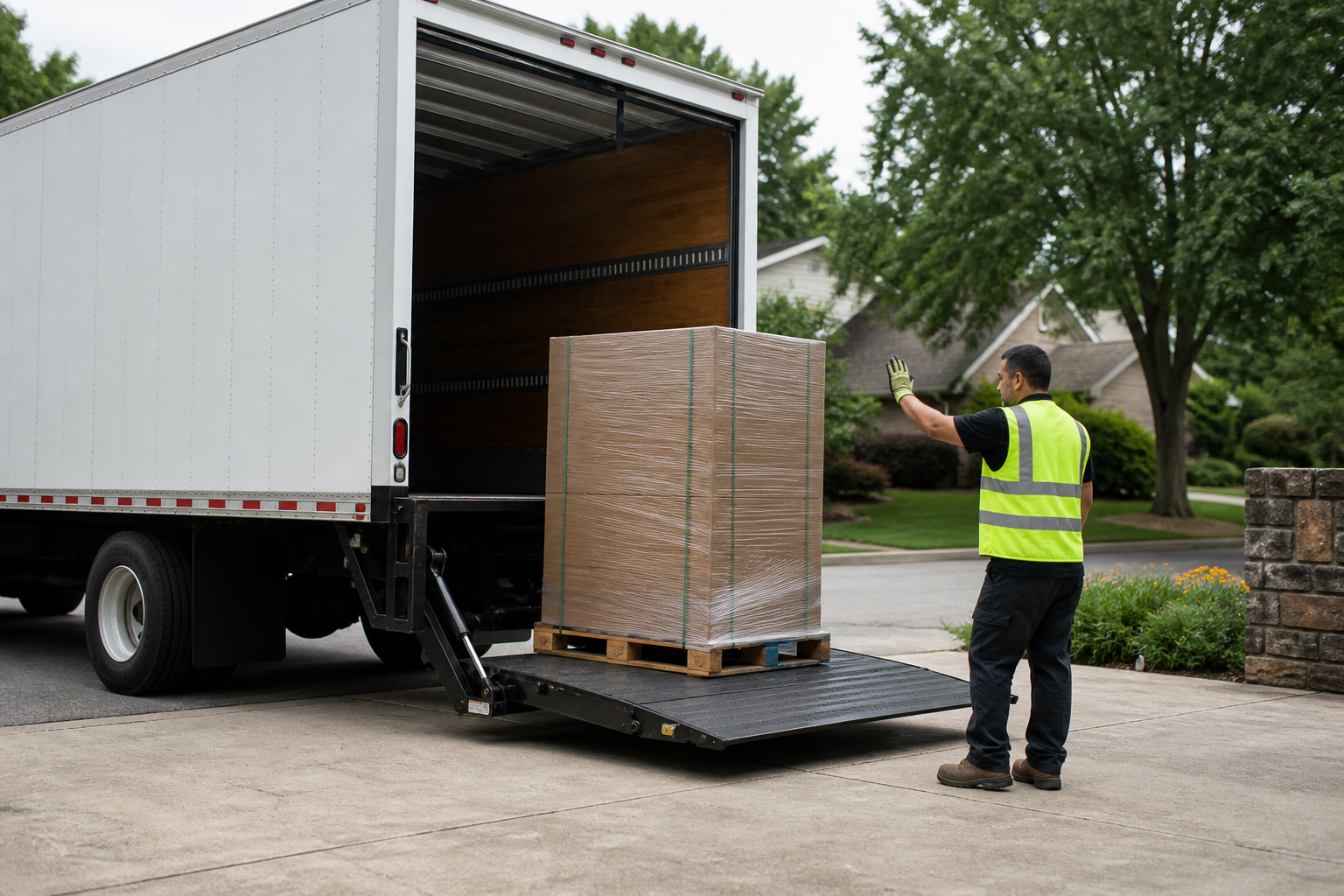
A liftgate lowers freight to ground level at addresses with no loading dock, the most common reason it gets added to a delivery.
When You Actually Need a Liftgate (And When You Don't)
The simplest test: does the delivery address have a loading dock that the truck can back into, at the right height, with someone there to receive freight with a forklift or pallet jack? If yes, you likely don't need a liftgate. If no, you almost certainly do. A few specific situations where shippers get this wrong:
- Residential deliveries — homes never have loading docks, so nearly every residential freight delivery over parcel size needs a liftgate by default. This includes furniture, appliances, home gym equipment and building materials delivered to a house.
- Small retail and strip mall locations — these often look "commercial" on paper but have zero dock infrastructure. A boutique, a salon, a small restaurant receiving equipment all fall into the same bucket as residential for liftgate purposes.
- Construction sites and trailers — no dock exists on an active job site, and ground conditions can make this trickier than a paved driveway.
- Warehouses and distribution centers with a dock — this is the one case where a liftgate is usually unnecessary, and paying for one anyway is wasted money.
The mistake we see most often isn't shippers requesting a liftgate they don't need, it's the opposite: assuming a business address has dock access when it doesn't, skipping the liftgate to save a line item, and then having a driver arrive unable to safely get freight off the truck. That turns into a failed delivery, a rescheduled appointment, and in some cases a redelivery fee that costs more than the liftgate would have. We walk through the broader set of reasons deliveries bounce back in why heavy deliveries fail at the door, and liftgate mismatches are consistently one of the top three causes.
Liftgate vs. Inside Delivery: Two Different Services
This is the single most common point of confusion on a freight quote, so it's worth spelling out clearly. A liftgate gets freight down off the truck and onto the ground, usually at the curb or the edge of a driveway. It does not include carrying that freight anywhere else. Inside delivery, sometimes called "white glove" depending on the level of service, is a separate accessorial that covers moving the freight from the curb into a garage, a specific room, up a short flight of stairs, or past some other obstacle.
Shippers sometimes assume liftgate service automatically means the driver will bring a refrigerator into the kitchen or a pallet of tile into the garage. It doesn't, unless that's booked and priced separately. A liftgate driver's job ends at ground level near the truck. If the receiver needs the freight moved further, that has to be arranged in advance, both for pricing and because it often changes how many people need to be on the truck.
The practical fix is simple: when you book a delivery, be specific about what happens after the freight touches the ground. "Curbside" means the liftgate gets it down and that's it. "Inside delivery" or "room of choice" means additional handling, and it should show up as its own line on the quote. Getting this distinction right before the truck leaves the dock avoids the awkward moment where a driver and a receiver disagree, in the driveway, about what was actually paid for.

Confirming access and liftgate needs before the truck leaves the dock, not after it arrives, is what keeps a delivery from bouncing back. Photo: Ali Mkumbwa / Unsplash.
How to Avoid Paying for a Liftgate Twice
The most expensive version of a liftgate isn't the one you book, it's the one you didn't book and end up paying for anyway. Here's the sequence that costs shippers money: the delivery arrives without a liftgate on the order, the driver can't safely unload 300+ lb of freight by hand, the delivery gets marked as failed, and it goes back on a truck for a second attempt, this time with the liftgate added, plus a redelivery fee. That second attempt often costs more than if the liftgate had just been on the original order.
A few habits prevent this:
- Ask the receiver directly whether the address has a loading dock. Don't assume based on whether it's "commercial" or "residential" on paper, ask the specific question.
- Confirm what happens after ground level. If the receiver expects the freight inside, that's a separate line item, and it's cheaper to add it upfront than to negotiate with a driver in the driveway.
- Flag unusual access conditions early. Narrow streets, gate codes, HOA restrictions, and steep driveways can all affect which truck shows up and whether a liftgate can even deploy properly.
- Get the liftgate requirement into writing on the BOL (bill of lading), not just a verbal note during booking, so it travels with the freight through every handoff.
If your shipments are recurring rather than one-off, it's worth having a conversation about setting up a standing delivery profile so liftgate and access requirements don't need to be re-confirmed every single time. That's part of what we cover when recurring deliveries should become a dedicated route.
Frequently Asked Questions
Does every residential delivery need a liftgate?
Almost always, yes. Homes don't have loading docks, so anything heavier or bulkier than a standard parcel, furniture, appliances, home gym equipment, building materials, needs a liftgate to get down off the truck safely. The exceptions are small, lightweight items that a driver can hand-carry, which is rare once you're above roughly 70-100 lbs.
Is liftgate service the same as inside delivery?
No, and this is the mix-up that causes the most delivery day disputes. A liftgate lowers freight to ground level, usually at the curb or driveway. Inside delivery, or "room of choice," is a separate service that covers carrying the freight past the curb, into a garage or a specific room. If you need both, both need to be booked.
What happens if I skip the liftgate and the address needs one?
The driver usually can't safely unload the freight without one, so the delivery gets marked failed and rescheduled. That second attempt typically comes with a redelivery fee, which often costs more in total than if the liftgate had been booked correctly the first time.
Can I add a liftgate after the shipment is already booked?
Sometimes, if there's enough lead time before the truck is dispatched. It's far more reliable to confirm liftgate need during initial booking. Once a truck without a liftgate is already en route, adding one usually means rescheduling rather than a same-day fix.
Does a liftgate cost the same for every shipment?
No. Rates reflect the weight and dimensions of the freight, whether the stop is residential or commercial, access difficulty at the address, and whether inside delivery is also needed. The most accurate way to get a number is to send us the addresses and shipment details directly through our service menu rather than relying on a generic estimate.