
Parcel, LTL or Final Mile: Shipping 150-1,500 lb
A practical decision guide for shippers moving palletized, crated or oversized freight that's too big for parcel and too small for a full truckload.
The gap between parcel and truckload
Parcel networks are built around a simple assumption: one box, one person can lift it, and a conveyor belt can sort it. Once a shipment gets past 150 lb, or it's palletized, crated, or oddly shaped, that assumption breaks down. Parcel carriers will surcharge it, mishandle it, or refuse it outright.
On the other end of the spectrum is full truckload, built for shipments that fill (or nearly fill) a 53 ft trailer on their own. If your shipment is a few pallets, or a single crated machine, or a pair of appliances, you're paying for space you don't use and waiting for a schedule built around someone else's freight.
The freight that falls in between, roughly 150 to 1,500 lb, doesn't have a natural home in either system. It's too big and too heavy for a parcel scanner and too small to justify its own trailer. That's the band this guide is about: palletized goods, crated equipment, appliances, furniture, fixtures, and anything else that needs a liftgate, a pallet jack, or two people to move it.
Shippers who don't know this middle band exists usually default to one of two mistakes. They either try to force the shipment through parcel (multiple boxes, hidden weight, and a high damage/return rate) or they overpay for a truckload slot they don't need. Neither gets the freight there faster or in better condition. The fix isn't a single service, it's matching the shipment to the right one of four options: local same-day delivery, final mile delivery, LTL (less-than-truckload), or a dedicated route for recurring volume.
What actually lands in the 150-1,500 lb band
This isn't a niche category. It covers more freight than most shippers realize once they start counting:
- Palletized goods moving warehouse to warehouse, warehouse to store, or warehouse to a job site.
- Crated equipment, industrial parts, or fixtures that need to stay upright and can't be tossed on a belt.
- Furniture and appliances sold direct to consumers or delivered to a business address.
- Bulky e-commerce orders that a customer bought online but that no parcel carrier wants to touch.
- Retail restock loads, from a single urgent case pack to a full pallet headed to a store shelf.
The quote intake at DirectXpress accepts shipments from under 150 lb up to 5,000 lb or more, but the core of what we move day to day sits in that 150 to 1,500 lb band. That's deliberate. It's the weight range where a shipper's options thin out the fastest: too heavy for the mailroom, too light to interest a truckload carrier, and often overlooked by freight brokers who are set up to move full trailers, not single pallets.
Knowing which category your shipment falls into changes more than which price bracket you land in. It changes what equipment shows up, whether you need an appointment window, whether the receiver needs a liftgate, and how many people it takes to get the freight off the truck. A shipper who identifies these details at booking, not after the truck arrives, avoids the redelivery problems that come from mismatched expectations.
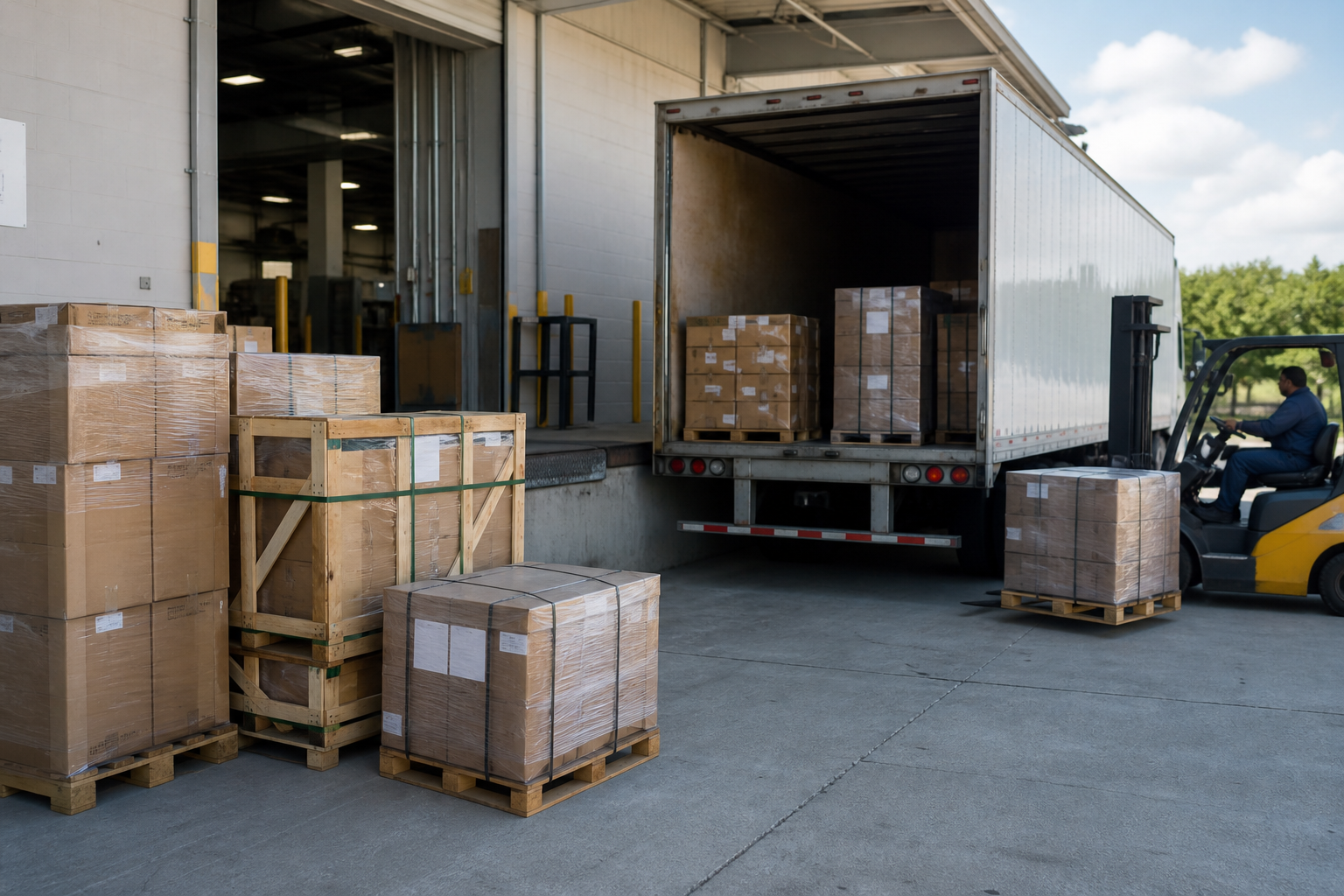
Palletized and crated freight staged for pickup: the kind of shipment that's too big for parcel and too small to justify a full trailer.
Option one: local same-day delivery
If the shipment is moving within the Inland Empire, Los Angeles County, or Orange County, and it needs to be there today, same-day local delivery is usually the right fit. This is a shipment that's booked in the morning and delivered before close, run on a box truck or straight truck rather than routed through a terminal network.
Same-day makes sense for warehouse-to-store transfers, urgent replenishment, a customer who can't wait for a multi-day LTL transit, or a job site that needs material today, not Thursday. It's a direct run, not a consolidated load, so the freight doesn't sit at a cross-dock waiting for other shipments to fill a trailer.
The tradeoff is geographic. Same-day only works within the service area it's built for. If your lane is Ontario, CA to a store in Anaheim or a warehouse in Riverside, that's a same-day fit. If it's Ontario to Sacramento, it isn't, and no local carrier will tell you otherwise without qualifying it heavily. Our same-day freight delivery service in Los Angeles covers palletized, crated, and oversized shipments with liftgate, appointment scheduling, and inside placement built in, not billed as an afterthought.
The other thing same-day delivery does well is handle urgency without treating every shipment like an emergency. It's a scheduled, same-business-day service, not a rush surcharge tacked onto standard freight. That distinction matters when you're deciding between same-day and a true hot-shot or emergency move, which is a different service built for a different kind of urgency.
Option two: final mile delivery
Final mile is the last leg of a longer supply chain, the segment that ends at a business address, a residence, or a job site rather than another warehouse. It's the piece of the journey where handling gets careful and specific: does the receiver have a dock, or does the driver need a liftgate? Is there an appointment window? Does the item need to go inside the building, or is curbside enough?
Final mile is where most heavy-freight delivery problems actually show up. A shipment can travel across the country without incident and still fail at the door because nobody asked whether the receiving address had loading dock access. That's why final mile is treated as its own discipline rather than the tail end of a truckload move.
Our final mile delivery service in the Inland Empire handles business, residential, and warehouse-transfer lanes with appointment scheduling, liftgate service, inside placement, and photo proof of delivery as standard parts of the job. The same applies to liftgate and inside delivery in Los Angeles, where the accessorials that heavy freight requires (liftgate, appointment, inside placement) aren't add-ons bolted onto a generic delivery, they're the core of the service.
Final mile matters most when the receiver isn't set up like a distribution center. A residential customer, a small retail storefront, or a job site trailer doesn't have a forklift or a loading dock. Planning for that in advance, rather than discovering it when the truck arrives, is the difference between a delivery that goes smoothly and one that gets redelivered a second time.
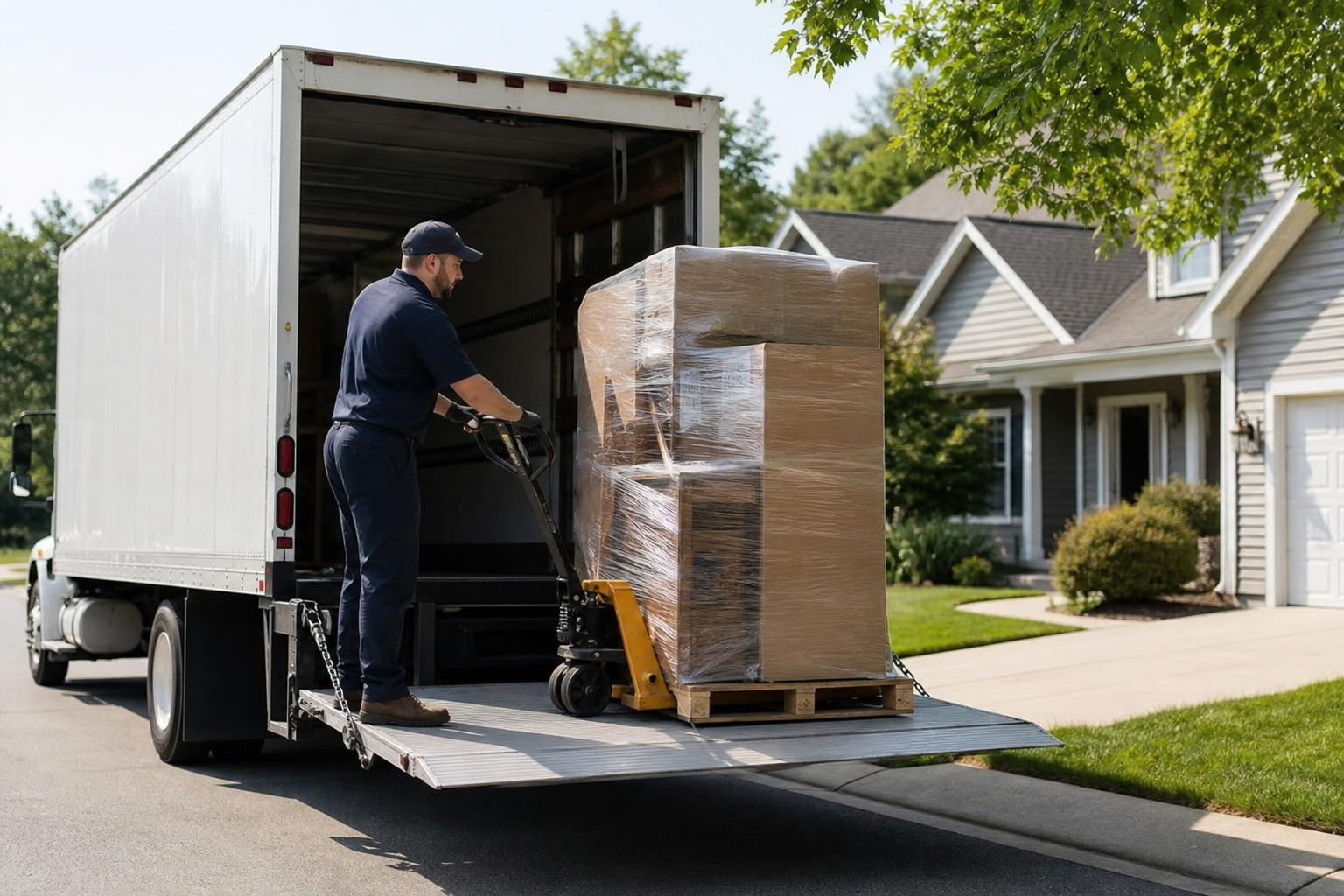
Final mile delivery to a residential address: liftgate service and careful handling matter more here than transit speed.
Option three: nationwide LTL
When the lane stretches beyond what a local fleet can cover directly, LTL (less-than-truckload) is the tool built for it. LTL consolidates multiple shippers' freight onto shared trailers, so you pay for the space your pallets take up rather than an entire trailer. That makes it the right fit for longer legs: cross-country moves, regional distribution runs, or any shipment where a full truckload isn't justified by the volume.
The tradeoff shippers need to plan for is transit time and handling touches. LTL freight typically moves through one or more terminals between origin and destination, which means more handling events than a direct local run, and a transit window measured in days rather than hours. That's a fair tradeoff for a shipment that doesn't need same-day speed, but it's worth planning around if your receiver has a tight appointment window.
Our LTL freight shipping service out of Ontario, CA pairs nationwide partner-carrier coverage with something most LTL bookings don't offer: one order record and one invoice across the whole move, plus local pickup on our own trucks before the freight ever reaches a partner carrier. That matters because a lot of the friction in LTL shipping isn't the transit itself, it's tracking a shipment across multiple carrier systems and reconciling paperwork from each leg.
LTL is the right call when the shipment is genuinely long-haul, when there's flexibility on delivery date, and when the freight is palletized well enough to survive multiple handling points. If any of those aren't true, and especially if the destination needs a tightly scheduled appointment, final mile or same-day local is usually the better fit even if the distance looks like an LTL lane on paper.
Option four: a dedicated route
The first three options assume a shipment is booked one at a time. Once a shipper is sending the same kind of freight to the same kind of destinations on a repeating basis, on-demand booking starts to look inefficient. That's the point where a dedicated route, sometimes called a milk run, is worth considering.
A dedicated route is a fixed-day, fixed-stop delivery pattern built around a shipper's actual volume: the same truck running the same stops on the same days, rather than each delivery being booked and dispatched independently. It fits retail chains restocking multiple stores, franchise networks with recurring supply needs, and distributors moving similar freight to a stable set of receivers.
The decision to move from on-demand to dedicated isn't about total volume alone. It's about density and predictability: enough stops on a tight enough geography, often enough, that a fixed schedule makes more sense than booking each one separately. A shipper with two stores getting restocked twice a month probably doesn't need a dedicated route yet. A shipper with twelve stores getting restocked twice a week probably does.
This isn't the right call for every growing shipper. Seasonal volume, a new territory still finding its shape, or freight that varies too much in type or destination from week to week doesn't fit a fixed route yet. In those cases, on-demand same-day or final mile bookings stay the better tool until the pattern stabilizes enough to justify a dedicated schedule.
How to decide: a quick framework
Run through these four questions before booking, in this order:
- How far is it going? Within the Inland Empire, LA County, or Orange County: local same-day or final mile. Beyond that: LTL.
- Is the receiver a business, a residence, or another warehouse? That determines whether you need liftgate service, inside placement, or a straightforward dock-to-dock handoff.
- Does it happen once or does it repeat? A one-off shipment is booked on demand. A recurring pattern to the same stops is a candidate for a dedicated route.
- How urgent is it, really? Same-day covers most urgency. True emergencies, a line-down part or a missed appointment that can't slip, call for a different service entirely.
Most shippers who default to LTL for everything, or who try to force heavy freight through a parcel network, are skipping this framework and picking the option they've heard of rather than the one that fits the shipment. The freight itself doesn't care what it's called. It cares whether the truck that shows up has a liftgate, whether the driver knows to call ahead, and whether the schedule matches what the receiver can actually handle.
You can see the full range of options, including how they connect for shippers who need more than one, on our services overview, or get a quote built specifically around your lane, weight, and destination type through our quote request page.
Frequently asked questions
What's the difference between LTL and final mile delivery?
LTL describes how the freight moves between terminals, consolidated on shared trailers over a longer distance. Final mile describes the last leg of a delivery, the segment that ends at the actual receiving address. A shipment can move by LTL for most of its journey and still need a final mile handoff at the end if the destination requires liftgate service or inside placement.
Can parcel carriers handle a 200 lb pallet?
Most parcel networks are built for boxes a single person can lift and sort by hand. A 200 lb palletized shipment typically gets surcharged heavily, delayed, or refused outright. Freight in that weight range is better served by a service built around pallets and liftgates rather than a conveyor belt.
Do I need a liftgate for every heavy delivery?
Not always, it depends on the receiving address. A warehouse or store with a loading dock usually doesn't need one. A residential address, a small storefront without a dock, or a job site almost always does. Confirming dock access before booking avoids a failed delivery attempt.
How do I know if my volume justifies a dedicated route?
Look at how many stops you're delivering to, how often, and how tightly clustered they are geographically. A recurring pattern of frequent stops in a stable territory is the clearest signal. Thin, seasonal, or geographically scattered volume usually isn't there yet.
What weight range does DirectXpress handle?
Our core service band is 150 to 1,500 lb, palletized, crated, and oversized freight, though our quote intake accepts shipments from under 150 lb up to 5,000 lb or more depending on the lane.