
Residential Heavy Delivery: What Furniture Brands Get Wrong
The recurring mistakes furniture and appliance brands make when planning residential final mile delivery, and how to avoid a failed drop.
Short answer: what does a residential pallet delivery need?
A residential pallet delivery needs three things settled before the truck leaves: a liftgate, because a home has no dock or forklift; a confirmed delivery window with someone home to receive the freight; and a clear plan for placement, meaning whether the pallet stops at the curb or driveway or has to be moved further in. Door width, stairs and parking access decide the rest. Final mile delivery that asks these questions at booking avoids most failed drops.
Residential delivery is a different problem than business delivery
Furniture and appliance brands often build their delivery expectations around commercial drops: a loading dock, a receiving clerk, a forklift or pallet jack already on site, and a building designed to move freight in and out. Residential delivery has none of that by default. There's no dock, no clerk, and often no clear path from the curb to the front door that a straight truck or box truck can use without some improvisation.
That gap is where a lot of residential deliveries go wrong before the truck even arrives. A brand that quotes and schedules a delivery the same way it would a business drop is setting up a driver to discover, on site, that the order needs a liftgate, or that the front door is thirty feet from the nearest legal parking spot, or that the item won't fit through the doorway at the angle the stairs require. None of that is the driver's fault, and none of it should be a surprise if the intake process asked the right questions upfront.
Getting residential heavy delivery right starts with treating it as its own category, not a smaller version of commercial delivery. The freight might be identical, a refrigerator is a refrigerator, but the environment it's arriving into changes almost everything about how the delivery needs to be planned.
Mistake one: not asking about the doorway before the truck arrives
The single most common failure point in residential heavy delivery is a mismatch between the item's dimensions and the path it needs to travel to get inside. A sectional sofa that fits easily through a standard 36-inch door can become an impossible fit once it has to turn through a narrow hallway or up a switchback staircase. A French door refrigerator that clears a doorway straight on may not clear it at the angle a tight entryway forces.
Brands that skip this question during order intake are gambling that the delivery will work out. Sometimes it does. When it doesn't, the options are all bad: the driver spends extra time on site trying different angles, the item goes back on the truck for a return trip, or worse, someone forces a fit and damages the item, the doorframe, or both.
A short set of intake questions solves most of this before the truck ever leaves the yard: What are the exact width and height of the front door and any hallway or stairwell the item has to pass through? Is there an alternate entrance, like a slider or a garage, that might offer a better path? Has anything this size been moved into the home before? None of these questions are complicated, but skipping them is how a routine delivery turns into a failed one.
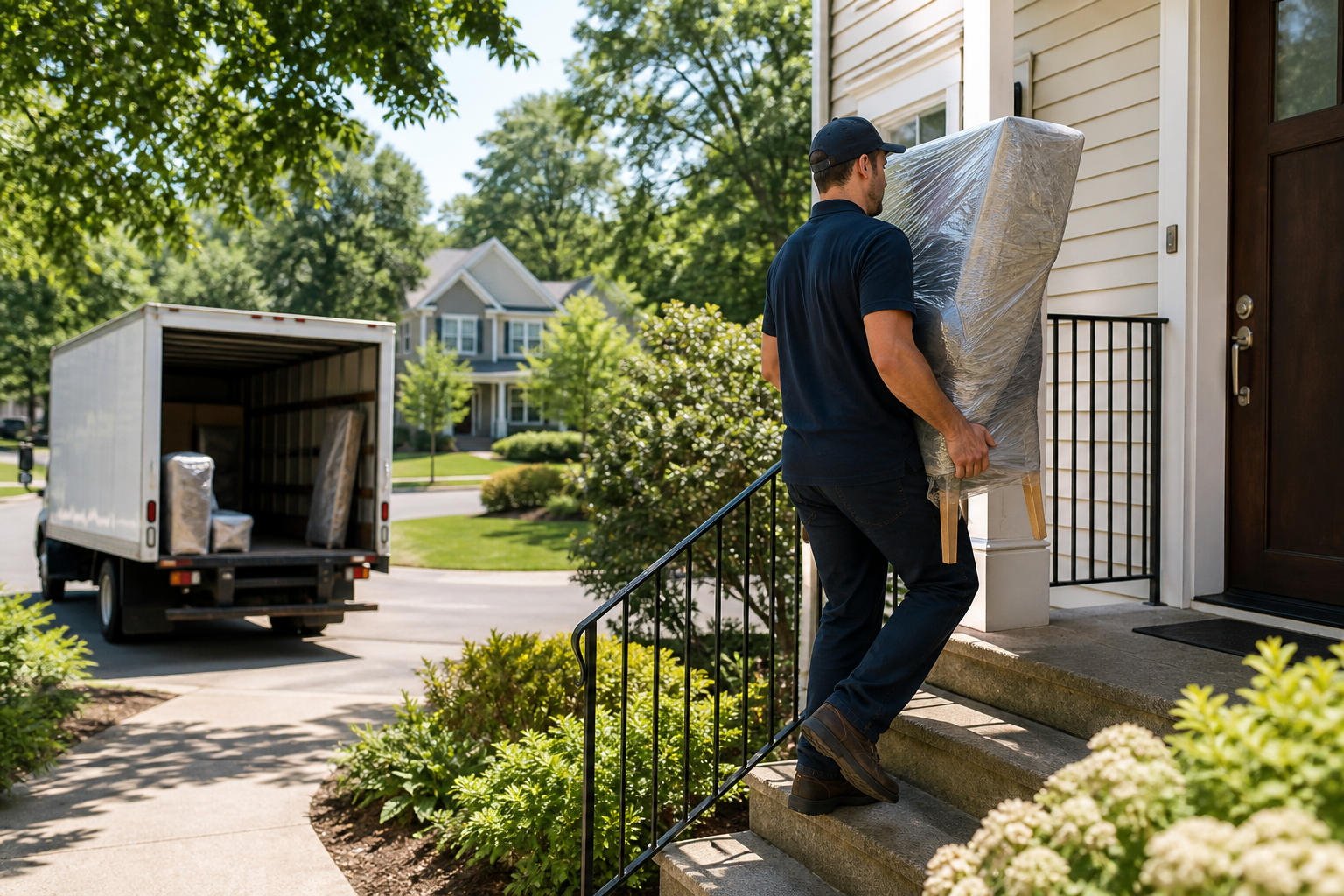
A doorway or stairwell that hasn't been measured ahead of time is the most common reason a residential delivery stalls on site.
Mistake two: assuming every home has a driveway a truck can use
Commercial planning assumes a loading dock or at least a large, accessible lot. Residential planning has to assume the opposite: narrow streets, no driveway, permit parking, a homeowners association with rules about trucks, or a delivery window that overlaps with school pickup traffic on a residential block. A 26 ft box truck that handles a business delivery without issue can struggle to find a legal, safe place to park within a reasonable carry distance of a house.
This matters most for heavier items that need a liftgate. A liftgate needs level, stable ground and enough clearance to lower safely, conditions that a sloped driveway or a curb-only parking situation may not offer. Brands that don't flag heavy or palletized items for liftgate service during scheduling put the driver in a position of either improvising without the right equipment or delaying the delivery to reschedule with the correct truck.
The fix isn't complicated: ask about parking and access at the same time as the doorway questions, and flag anything over a manageable hand-carry weight for liftgate delivery from the start. A shipment that's correctly flagged for liftgate service at booking rarely turns into a problem on delivery day. One that isn't flagged is a coin flip.
Mistake three: no one confirms who will be home
A heavy item delivered to a residence almost always needs someone present to accept it, sign for it, and in many cases help guide the driver on where it should go inside the home. Brands that schedule a delivery window without confirming someone will actually be there are setting up a missed delivery, which then requires a reschedule, additional dispatch time, and a second trip that adds cost and delay for everyone involved.
This sounds obvious, but it's one of the most frequent breakdowns in residential delivery, especially for online furniture and appliance orders where the purchase and the delivery scheduling happen days or weeks apart. A confirmation call or text the day before, and again the morning of, closes most of this gap. It also gives the customer a chance to flag last-minute access issues, like a gate code that changed or a car blocking the driveway, before the truck is already on its way.
Final mile delivery to a residence, whether it's a one-off delivery or part of a recurring program for a furniture retailer, works best when the receiving side is treated as seriously as the shipping side. Final mile delivery across the Inland Empire depends on that coordination happening before the truck leaves, not after it arrives and finds no one home.
Mistake four: treating proof of delivery as an afterthought
Residential delivery disputes are more common than commercial ones, in part because there's no receiving clerk to inspect and sign off on freight condition the way a business might. A customer who wasn't home to watch the unload, or who doesn't check the item until later that evening, may raise a damage claim days after the fact with no clear record of the item's condition at drop-off.
Photo and signature proof of delivery closes that gap. A timestamped photo of the item in place, along with a signature or a documented delivery confirmation, gives both the brand and the shipper a clear record of what was delivered, where, and in what condition. Without it, a damage dispute becomes a matter of he-said-she-said between a customer and a brand that has no way to verify what happened at the door.
Brands that build proof of delivery into every residential drop, not just the ones that seem likely to have problems, save themselves the much larger cost of an unresolvable dispute down the line. It's a small step at delivery time that prevents a much bigger conversation later. Customers can prepare for their side of the drop with what to expect when a pallet is coming to your house.

Confirming who will be home, and documenting condition on arrival, turns a routine drop into a clean one.
Building residential delivery into the order flow, not bolting it on after
The brands that get residential heavy delivery right don't treat it as a special case handled by a phone call after checkout. They build the intake questions into the order flow itself: doorway and hallway dimensions, stairs, parking access, and a confirmed delivery contact, all captured at the point of sale or in a short follow-up before the delivery is scheduled. That data then travels with the order to whoever is dispatching the truck, so the driver shows up already knowing what kind of access to expect.
This matters even more for brands running recurring volume into the same region, where the same access patterns show up again and again. A furniture retailer shipping into dense urban neighborhoods will see recurring street parking constraints. An appliance brand serving a suburban market will see more two-story homes with tight staircases. Once a shipper has visibility into those patterns, they can staff and equip routes accordingly, rather than treating each delivery as a fresh unknown.
Working with a shipping partner that handles both the freight and the residential coordination, rather than splitting the job between a long-haul carrier and a separate local delivery crew, keeps that information from getting lost in the handoff. Fewer parties touching the order means fewer places for the doorway measurement or the access note to get dropped between booking and delivery day.
Frequently asked questions
What does a residential pallet delivery need?
It needs a liftgate truck, because a home has no dock or forklift to take the pallet off the truck; a confirmed delivery appointment with someone present to receive it; and an agreed placement, such as curb, driveway, garage or inside the home. Door widths, stairs and truck parking should be checked at booking. Our final mile delivery service quotes liftgate, appointment and inside placement when they are selected.
Do I need a liftgate for a residential delivery?
Usually yes. A liftgate lowers a pallet or heavy item from truck bed height to the ground when there's no dock or forklift, which describes most homes. Flag it at booking so the right truck is dispatched. See the liftgate delivery page for how it works.
Is a delivery appointment included with residential freight?
Not always. A scheduled window or call-ahead is its own service on many quotes, so ask whether it is included. Confirming it also lets the customer arrange for someone to be home, which prevents a missed delivery and a second trip.
Will the driver bring the pallet inside the house?
Not by default. Inside placement is a separate service, and the quote needs to say how far in, which room or floor, and whether there are stairs or narrow doors. Without it, freight is typically left at the point where the truck unloads, such as the driveway or garage opening.
What's the biggest difference between residential and commercial heavy delivery?
Commercial delivery assumes a loading dock, a receiving clerk, and equipment already on site to move freight. Residential delivery has none of that by default, so the truck, the crew, and the equipment have to be matched to each home's actual doorway, stairs, and parking situation ahead of time.
How do I know if my delivery needs a liftgate?
Any item too heavy to hand-carry safely down from truck bed height, or any palletized shipment, should be flagged for liftgate service at booking. Waiting until the truck is on site to discover the item needs a liftgate almost always means a delayed or rescheduled delivery.
What should a brand ask customers before scheduling a heavy residential delivery?
At minimum: the width and height of the front door and any hallway or stairwell the item must pass through, whether an alternate entrance exists, whether parking near the home is realistic for a delivery truck, and who will be present to receive and sign for the item.
Why do residential deliveries have more damage disputes than commercial ones?
There's usually no receiving clerk inspecting freight condition at drop-off, so without photo and signature proof of delivery, a claim raised days later has no record of the item's condition when it arrived.
Does DirectXpress handle residential final mile delivery for furniture and appliance brands?
Yes. Residential coordination, liftgate service, and proof of delivery are built into our final mile delivery service for furniture and appliance shippers moving freight into homes across the region.
About the author
DirectXpress Dispatch
Dispatch and Operations, DirectXpress
The dispatch team at DirectXpress, an Ontario, CA freight company holding both broker and motor carrier authority (MC 1801477 / USDOT 4539992). Same-day LA County freight, heavy final mile for 150-1,500 lb shipments, and nationwide LTL.