
How to Palletize a Shipment That Survives the Trip
Pallet choice, stacking rules, strapping technique, labeling, and the photos that support a damage claim — the hands-on guide.
Short answer: stack boxes tightly on a 48x40 pallet (column-stack the layers for strength, interlock the top layer for stability), keep every carton inside the pallet edge, wrap and strap the load so it moves as one unit, and label every side. Then photograph it before pickup.
A pallet that survives the trip is built in four moves: pick a pallet rated for the load, stack heavy-low and square to the edges, wrap so the load and the pallet become one object, then label and photograph before it leaves. Everything else in this guide is detail hanging off those four.
Getting them wrong invites avoidable damage: cartons overhanging the edge, heavy boxes stacked on light ones, too little stretch film holding too much load. A badly built pallet can be refused at pickup, reclassed after it, or delivered crushed — and your own packaging photos can then count against the claim. Building a pallet that survives the trip is not skilled labor. It's a short list of things done in the right order.
Start with the right pallet
- Size: 48x40 unless you have a reason. The 48x40 in GMA footprint is the North American standard pallet (see our standard pallet sizes guide). Odd sizes can create handling exceptions, and exceptions can add fees and damage risk.
- Condition: boringly sound. No cracked stringers, no missing deck boards, no protruding nails. A pallet that flexes when you rock it will flex under a forklift with your freight on top.
- Wood vs. plastic: wood pallets can be repaired; plastic is an alternative where wood-packaging rules apply to exports (look for the ISPM-15 stamp on wood going international).
- Weight rating: the pallet has to be strong enough for the load it carries, so check its rated capacity against the actual weight and the way it will be handled — ask the supplier if the rating isn't marked — and say the weight out loud when quoting.
No pallet on hand? Pallet suppliers sell new and used ones; check a used pallet's condition before loading it. See also our guide to the 150–1,500 lb range.
Stack like the trailer is trying to destroy it
Because it is. Every pallet rides through acceleration, braking, dock bumps, and neighboring freight. The stacking rules exist to survive exactly that:
- Heavy low, light high. Weight above the midline turns braking into tipping. The densest cartons form the base layer, always.
- Zero overhang. Anything past the pallet edge takes every impact directly and can hurt recovery on a damage claim under the applicable terms. If cartons don't fit inside the footprint, use a bigger pallet or two pallets — overhang also inflates your dimensions, and dimensions drive price.
- Column vs. interlocked: column stacking (boxes aligned corner-over-corner) increases top-to-bottom compression strength in almost all cases, according to FedEx's pallet packing guidance — corners are where cartons are strong. Interlocking (brick-style) adds stability but costs crush resistance. The working compromise: column-stack the layers, then interlock only the top layer or cap it with a flat sheet.
- Keep layers level. A pyramid sheds boxes; a level top takes a cap sheet and straps cleanly. Fill voids inside layers with dunnage so nothing shifts into the gap.
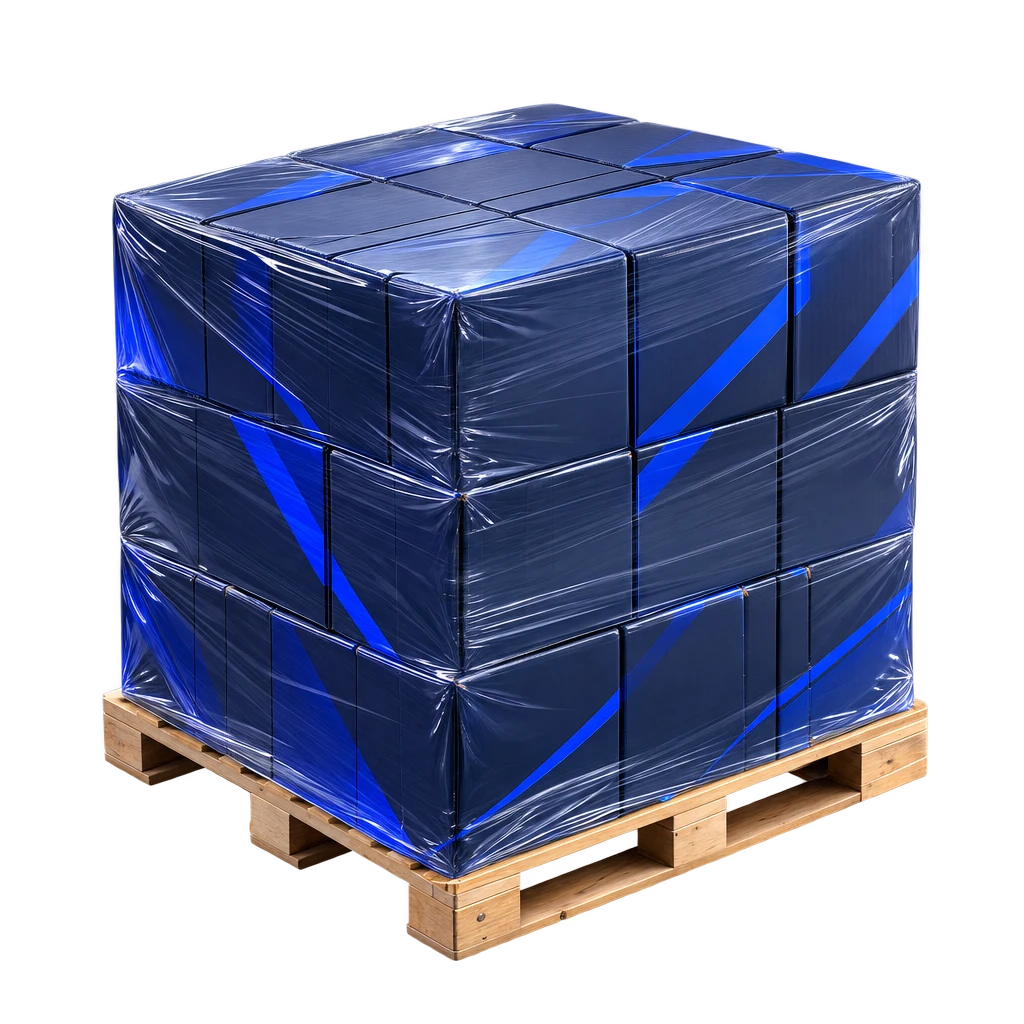
Wrap and strap so the load and pallet are one object
A wrapping mistake to avoid: film around the boxes, never around the pallet. That makes a tidy bundle sitting loose on a skid — the bundle slides off intact. The goal is one rigid unit:
- Anchor to the pallet. Start the film low enough to catch the pallet's base or feed a corner of film through a stringer opening, then wrap upward. The bottom two or three revolutions should bind cartons to wood.
- Enough film to hold the load. There is no single wrap count for every load. FedEx's pallet guidance calls for 70-gauge stretch wrap that clings to itself and for reaching the minimum containment force needed to secure the load to the pallet; heavier and taller loads need more. Hand film stretches as you pull; that tension is the point.
- Strapping for anything heavy or machine-like. Poly or steel banding, two straps each direction, over the top and through the pallet openings. Film keeps rain and fingers out; straps keep a 700 lb machine married to the skid.
- Corner boards under the straps. Cardboard or plastic edge protectors spread strap tension and armor the exact edges that forklifts and neighboring pallets hit first. They protect exactly those edges.
Label, photograph, and hand it over right
A pallet's paperwork armor matters as much as its film. Label at minimum two adjacent sides — ideally all four — with the delivery address, the piece count ("Pallet 1 of 2"), and any handling flags (This Side Up, Do Not Stack, Fragile). Put a duplicate packing slip inside the wrap on top. If the load must not be double-stacked, say so on the label and on the bill of lading; a sticker alone binds nobody.
Then photograph everything, timestamped, after wrapping and again as it's loaded: all four sides, the labels, the top. Those photos are supporting evidence of the pallet's condition at pickup if a claim follows. Photo documentation is standard on our own runs — every DirectXpress delivery closes with photo proof of delivery — and your pickup photos are the matching bookend.

The special cases
- Drums: band them to the pallet in a tight group, plug caps up, with a cap sheet if anything rides above. Loose drums roll; banded drums ride.
- Machinery: follow the machine manufacturer's transport instructions for tie-down points and fluids, or have a qualified rigger prepare it; the unit must not be able to walk on the skid. Secure loose parts as those instructions direct, and declare motors and batteries when quoting — the same rule as any heavy single item.
- Mixed cartons: heaviest and most uniform on the bottom, build toward a level top, and never let one fragile odd-shaped box become the load's roof. If it can't ride inside the stack, it ships as its own piece.
- Bagged goods: interlock by necessity, cap sheet on top, extra wrap — bags shift more than boxes and the film does more of the work.
What a driver can refuse at pickup
Drivers are the first inspection your freight faces, and they can decline anything that endangers the rest of the trailer: visible overhang, leaning stacks, unwrapped loose cartons, a cracked pallet flexing under load, leaking or fuming containers, or freight that plainly doesn't match the description on the bill of lading. A refusal costs you the pickup window and can bring a fee. Everything above exists to make the driver's decision easy in your favor.
And if a pallet is borderline, say so when you book rather than hoping. On our same-day LA County runs, liftgate and pallet jack equipped trucks with DirectXpress drivers handle freight at addresses without docks — but the pallet still has to be one solid object when the liftgate comes down. Not sure your load qualifies? Describe it in a quote request — weight, dimensions, how it's packed — and we'll tell you what to fix before pickup day, not during it.
FAQ: Palletizing freight
How do you palletize boxes?
Put the heaviest, most uniform boxes on the bottom layer of a sound 48x40 pallet, with every carton inside the pallet edge and no overhang. Column-stack the layers corner over corner for compression strength, interlock or cap the top layer for stability, and keep each layer level. Then wrap stretch film starting low on the pallet itself so the boxes and wood become one unit, add corner boards and straps if the load is heavy, and label the sides.
How do you palletize a shipment step by step?
First, choose a sound 48x40 pallet and check its rated capacity against the weight. Second, build the base layer from the densest cartons, with no overhang. Third, stack the remaining layers heavy-low and light-high, column-stacked and level, filling voids with dunnage and capping the top. Fourth, wrap the film from the pallet base upward, adding corner boards and straps for heavy freight. Fifth, label at least two adjacent sides, ideally all four, with address, piece count and handling flags. Sixth, photograph all four sides and the top, and put the real weight and dimensions on the bill of lading.
What is a palletized shipment?
A palletized shipment is freight stacked, wrapped and secured on a pallet so it can be moved as a single unit by forklift or pallet jack, instead of box by box. It's the standard form for LTL and final mile freight, and the pallet's weight and finished dimensions drive how it's quoted. They also feed the freight class on class-rated LTL, so measure the finished pallet, not the loose boxes.
How many times should I wrap a pallet with stretch film?
There is no single count that suits every load. FedEx's pallet guidance calls for 70-gauge stretch wrap that clings to itself and for reaching the minimum containment force needed to secure the load to the pallet, with the first wraps anchored to the pallet itself. Heavier or taller loads need more. The goal is a load and pallet that move as one object.
Can boxes hang over the edge of the pallet a little?
No. Overhang takes impacts directly, weakens carton compression strength, can affect recovery on a damage claim under the applicable terms and evidence, and increases your billed dimensions. If it doesn't fit inside 48x40, use a larger pallet or split the load.
Is it better to stack boxes in columns or interlocked like bricks?
Columns for strength — cartons carry load at their corners, and FedEx's pallet guidance says column stacking increases top-to-bottom compression strength in almost all cases. Interlock only the top layer, or cap the stack with a flat sheet, to get stability without giving up the strength below.
How heavy can a single pallet be?
As heavy as the pallet's rated capacity allows for the way it will be handled — check that rating against the actual load. Beyond the pallet, the constraints are load stability, the equipment at both ends, and honest declaration. State the real weight when quoting.
Do I need to put anything between the boxes and the straps?
Yes — corner boards (edge protectors) wherever straps cross an edge. They spread strap tension so the strap can be genuinely tight without cutting cartons, and they protect the edges that take forklift and neighbor-pallet contact in transit.
What should I photograph before the truck arrives?
All four sides of the finished pallet, the labels, the top, and a shot as it's loaded — all timestamped. Those photos are evidence of the pallet's condition at handoff if a damage claim follows.
About the author
DirectXpress Dispatch
Dispatch and Operations, DirectXpress
The dispatch team at DirectXpress, an Ontario, CA freight company holding both broker and motor carrier authority (MC 1801477 / USDOT 4539992). Same-day LA County freight, heavy final mile for 150-1,500 lb shipments, and nationwide LTL.