
Standard Pallet Sizes: A Shipper's Reference
GMA 48x40 and the other common footprints, weight ratings, ISPM-15, and how pallet choice affects freight class.
The North American standard pallet is 48 x 40 inches — the GMA footprint. Europe's counterpart is the 1200 x 800 mm EUR/EPAL. A few other sizes serve particular industries: 42 x 42 is associated with telecommunications and paint, 48 x 48 with drums.
Those dimensions feed straight into your freight bill. The footprint decides how many units fit a trailer, whether the load overhangs (and gets bumped, and re-measured), and how much space it takes up. Material and treatment — not size — decide what happens at an international border. Below: the size tables, then the handful of rules that connect pallet choice to price.
The North American standard: 48 x 40
The GMA pallet — 48 inches by 40 inches, named for the Grocery Manufacturers Association — is the default unit of North American freight. It is the size listed first among North America's common pallets, and warehouse racking, dock equipment and carrier planning in North America are largely built around it. Unless your freight has a specific reason to sit on something else, a 48x40 is the natural starting point.
Look for true (full) four-way entry. "Four-way" gets used loosely: a notched stringer pallet can be picked up by a forklift from all four sides, but a hand pallet jack cannot enter through the notched sides. On a 48x40 stringer pallet, that means a hand jack goes in only through the 40-inch ends, while the notched 48-inch sides take forklift tines. A block pallet with full four-way entry takes both forks and pallet jacks from every side — CHEP, for example, describes its pooled 48x40 block pallet as "true 4-way entry" compatible with standard pallet jacks and forklifts. If the delivery end will move the pallet by hand jack, check which kind you have before it ships.
The size tables
The international standard ISO 6780 lists six pallet plan sizes — three rectangular and three square. The standard gives the sizes; which regions use which is covered in an informative annex, so the notes below mark only the two sizes this guide discusses:
| Footprint (mm) | Footprint (in) | Note |
|---|---|---|
| 1219 x 1016 | 48 x 40 | The North American GMA size |
| 1200 x 1000 | 47.2 x 39.4 | |
| 1200 x 800 | 47.2 x 31.5 | The EUR/EPAL pallet |
| 1067 x 1067 | 42 x 42 | |
| 1100 x 1100 | 43.3 x 43.3 | |
| 1140 x 1140 | 44.9 x 44.9 |
Within North America, the most common sizes and the industries they are usually associated with:
| Footprint (in) | Commonly associated with |
|---|---|
| 48 x 40 | Grocery and most general freight |
| 42 x 42 | Telecommunications, paint |
| 48 x 48 | Drums |
These are associations, not rules: plenty of freight in every industry ships on a 48x40, and custom sizes are common for odd-shaped goods. The EPAL Euro pallet measures 1,200 x 800 x 144 mm and EPAL calls it the most widely used exchange pallet in the world. Shipping internationally? It is worth matching the destination's pallet system, because a footprint that doesn't match the racking and containers on the other end wastes space there.
Height: the dimension that prices the trailer
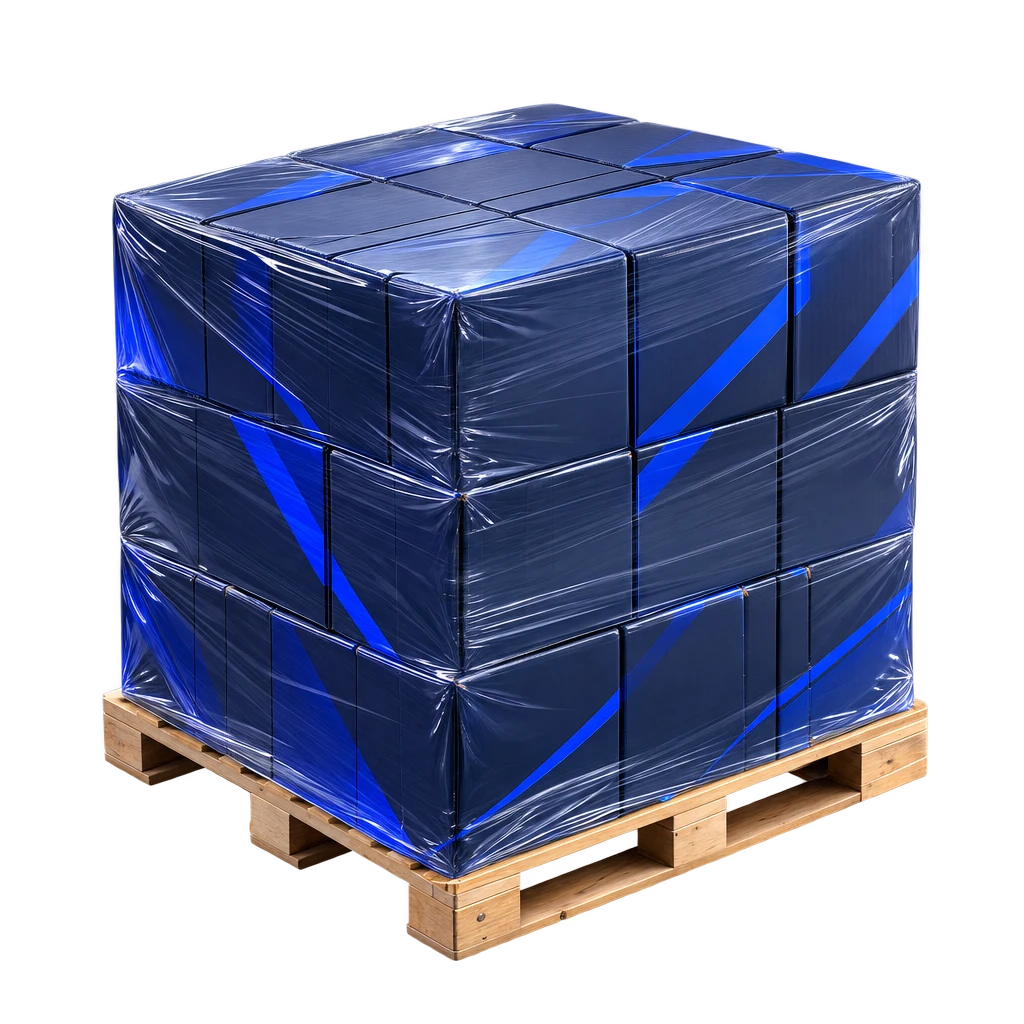
A bare pallet is only a few inches tall — CHEP lists its 48x40 at 5.6 inches, EPAL its Euro pallet at 144 mm. What matters for pricing is loaded height, because carriers think in space as well as weight. Trailer interior heights vary by equipment, so if you are hoping two loads will stack inside one trailer, ask the carrier for the interior height of the equipment it plans to send rather than assuming. Height shows up in your price in two main ways:
- Stackability. A pallet that can safely carry another load on top lets the carrier use the space above it; one that can't leaves that space empty. Whether a load can be stacked depends on its packaging and contents actually bearing the weight — a flat top alone doesn't make it stackable — so tell the carrier honestly, and mark a load that can't take weight as non-stackable.
- Density. Loaded dimensions set the cubic feet, and weight divided by cube is density — one of the four characteristics the NMFTA uses for freight classification, alongside handling, stowability and liability. In the NMFTA's words, "the denser and easier to move, the lower the class—and the lower the cost."
Footprint and height also decide which truck can serve the delivery. A tall pallet that clears a loading dock easily may need a different kind of vehicle at an address without one — dock-high trailers versus liftgate box trucks covers which sites can take which.
Weight ratings: read the pallet's own spec
There is no single weight rating for "a wood pallet." Capacity depends on the design, the materials, the pallet's condition, how the load is spread, and whether the pallet is sitting on the floor, being lifted, or spanning a rack. Manufacturers publish ratings for particular conditions, and the conditions matter as much as the number. Two published examples:
- CHEP pooled 48x40 block pallet: 2,800 lb "in normal operating circumstances with a uniformly distributed load," and block-stacked up to five unit loads high, not to exceed 10,000 lb.
- EPAL Euro pallet: a safe working load of 1,500 kg per pallet, and up to 5,500 kg on the bottom pallet when stacked on a solid surface.
Those figures belong to those specific pallets under those conditions; they aren't a rule of thumb for any pallet of the same size. For a heavy or concentrated load — machinery, stone, a single dense item sitting in the middle of the deck — get the rating for the pallet you're actually using, or ask the supplier for one built for the load. A pallet that fails mid-lift turns an ordinary shipment into a damage claim.
Materials: wood, plastic, processed wood
Solid wood pallets are repairable and easy to find used. Plastic pallets can be washed and reused, which suits closed loops where pallets come back to the shipper; get a quote for both, since the cost trade-off depends on how many trips a pallet makes. Processed wood pallets — plywood, particle board, oriented strand board and similar materials made with glue, heat and pressure — matter mainly for export, because under U.S. and Canadian rules they are not regulated as wood packaging material (next section).
Going international: ISPM 15
ISPM 15 is the international standard for wood packaging material, including pallets. For shipments into the United States, USDA APHIS requires regulated wood packaging to be treated and to carry the ISPM 15 mark: the IPPC logo, a two-letter country code, a unique facility number, and the treatment code — "HT" for heat treatment or "MB" for methyl bromide. APHIS states that shipments containing noncompliant wood packaging "will not be allowed to enter the country," and corrective actions can include destruction under APHIS supervision or re-export.
Two points that often get missed:
- The mark is about treatment, not size. A 48x40 and a Euro pallet face the same rules. What matters is the material and whether it was treated and marked. Canada's directive lists heat treatment (conventional or dielectric), methyl bromide and sulphuryl fluoride as approved treatments.
- Not every border crossing needs it. Canada exempts wood packaging made entirely of continental U.S. or Canadian origin wood in trade between the two countries, and both APHIS and Canada treat processed wood such as plywood and OSB — and, per APHIS, plastic pallets — as outside the rule. Requirements differ by destination, so check the importing country's rules before you build an export load.

Reusing pallets: a quick inspection
Used pallets are common and often perfectly usable, but look before you load. EPAL, for its exchange pallets, treats a pallet with a missing board, a broken block, a splintered deck or a board broken across its width as unfit for exchange until it is repaired — a reasonable checklist for any pallet. Add protruding nails, cracked stringers (the long rails on a stringer pallet), and rot. Visual inspection only rules pallets out; it doesn't tell you what a pallet can carry. For a heavy load, a used pallet of unknown history is a gamble a new, rated pallet avoids.
Overhang: the small mistake that compounds
Freight hanging past the pallet edge is one of the most avoidable problems in palletized shipping. The overhanging edge takes the knocks from neighboring loads and forklifts, and it can crush or tip under stacked weight. It also changes your measurements: a load is measured at its outermost points, so a 52-inch-wide load on a 48x40 is a 52-inch-wide load, and the extra cube can change its density and class. If damage does happen, the carrier will look at how the freight was packaged, so an overhanging load gives you a weaker position. If the item is bigger than the pallet, size up the platform (a 48x48, or a custom skid) rather than letting it hang. Full loading technique — stacking, strapping, wrap — lives in our palletizing guide.
The two-minute pallet decision
- Start from a 48x40 unless the freight or the destination says otherwise; pick full four-way entry if the receiver will use a pallet jack.
- Bigger than the deck? Bigger pallet, no overhang.
- Keep it low and tight, and describe stackability honestly.
- Heavy or concentrated load? Use a pallet rated for it, and check the rating's conditions.
- Crossing a border? Check the destination's wood packaging rules; treated-and-marked wood, processed wood or plastic are the usual answers.
- Measure the loaded pallet — footprint and height — and quote with those numbers, not the catalog dimensions of what's on it.
FAQ: Pallet sizes and specs
What is the standard pallet size in the U.S.?
48 x 40 inches — the GMA pallet. It is the first-ranked of North America's common sizes and a footprint U.S. racking and freight planning are commonly built around.
How many standard pallets fit in a 53 ft trailer?
A common planning figure is 26 pallets on the floor loaded straight (two rows of 13), with some turned-loading patterns fitting more. The real number depends on the trailer's interior dimensions, the loads' weight and whether they can be stacked, so confirm with the carrier. Once your count climbs toward a full trailer, the pallet count where a full truckload beats LTL becomes the question worth pricing.
How much weight can a wood pallet hold?
It depends on the pallet. Ratings are specific to a design and to conditions such as an evenly spread load. CHEP rates its pooled 48x40 block pallet at 2,800 lb in normal operation with a uniformly distributed load; EPAL rates its Euro pallet at 1,500 kg. For heavy freight, get the rating for the pallet you are using.
What does the ISPM 15 stamp mean and do I need it?
It shows that wood packaging was treated under the ISPM 15 standard. The mark carries the IPPC logo, a country code, a facility number and a treatment code such as HT (heat treatment) or MB (methyl bromide). The U.S. and Canada require it on regulated wood packaging entering the country, and other countries set their own import rules. Exceptions exist — processed wood and plastic pallets, and U.S.- or Canadian-origin wood in U.S.–Canada trade — so check the destination's rules.
Can my freight hang over the edge of the pallet?
It can, but it costs you: the overhang takes damage, it weakens your position if you have to file a claim, and your freight is measured at its widest point. Size the pallet to the freight instead.
Does pallet choice affect my freight class?
Indirectly. Footprint and loaded height set your cubic feet, and weight divided by cube is density, one of the four characteristics used to classify freight. A compact load with no overhang takes up less space, which can lower density-related charges for the same freight.
About the author
DirectXpress Dispatch
Dispatch and Operations, DirectXpress
The dispatch team at DirectXpress, an Ontario, CA freight company holding both broker and motor carrier authority (MC 1801477 / USDOT 4539992). Same-day LA County freight, heavy final mile for 150-1,500 lb shipments, and nationwide LTL.