
Proof of Delivery That Actually Settles a Dispute
What real proof of delivery looks like for freight and residential shipments, and why a bare signature leaves a damage claim open.
Why a signature alone is not enough
Proof of delivery is easy to think of as a signature on a bill of lading. A driver hands over a clipboard, the customer signs, the truck leaves. The problem is that a signature only confirms something arrived. It says nothing about what condition it arrived in, whether the count matched the order, or where exactly it was left.
When a damage claim shows up three days later, a bare signature doesn't help either side. The shipper can't prove the item left the truck intact. The customer can't prove it was already damaged when the crew set it down. Both parties end up arguing from memory, and memory is a bad record to build a claims process on.
This gap is where freight claims and residential delivery disputes can get expensive. Without a documented condition at the moment of handoff, both sides are left arguing over what happened. That's an unstable way to run a claims process, and it's avoidable with a small change in what "proof of delivery" is actually required to include.
What real proof of delivery actually includes
Proof of delivery that holds up in a dispute has four parts. The first is a timestamped photo of the item in place, at the point of delivery, before the crew leaves the site. It is useful evidence in a later dispute because it shows condition and placement at the moment control changes hands.
The second is a signature or an electronic delivery confirmation from someone authorized to accept the shipment, not just whoever happened to answer the door. The third is a documented item count or piece count, especially for multi-piece furniture orders or palletized freight where a partial delivery can otherwise get logged as complete. The fourth is a note of any exceptions: visible damage to packaging, a missing piece, or a delivery location that differs from the original instructions, like a garage drop instead of an inside placement.
Together, these four pieces turn "delivered" into a specific, checkable claim instead of a vague assertion. A shipper who can produce a timestamped photo, a signature, a piece count, and an exception note for a delivery has a real answer when a customer disputes the condition or completeness of what arrived. A shipper with only a signature has nothing but a name on a clipboard.

A timestamped photo at the moment of handoff records condition and placement when control changes hands.
Why the standard is different for freight than for parcel
For a small, low-value parcel, a doorstep photo and a GPS pin may be the whole record, and the cost of a wrong claim is small. Freight and final mile delivery of furniture, appliances, and other heavy items work under completely different economics. A single damaged item can be worth thousands of dollars, and a disputed multi-piece order can tie up a claims team if the paperwork is thin.
That's why LTL and final mile freight benefit from a fuller proof of delivery standard than parcel (our parcel, LTL, or final mile comparison covers where each fits): piece counts that match the bill of lading, photos of each major item, and a signature tied to a specific delivery address and time. Residential deliveries add another layer, because there may be no receiving clerk on-site checking freight against a manifest the way a commercial warehouse would. The driver may be the only party inspecting the shipment before it becomes the customer's problem, which is why the driver's documentation matters in a later dispute.
Shippers who scale into recurring residential volume, the kind covered in our piece on when recurring deliveries should become a dedicated route, find that proof of delivery consistency becomes even more important. A dedicated route means the same drivers, the same customers, and the same expectations repeating weekly, so a single skipped documentation step can turn into a pattern of disputes across dozens of deliveries.
What happens when proof of delivery is missing or thin
When a claim comes in and the proof of delivery on file is just a signature, the shipper is negotiating from a weak position no matter how the delivery actually went. Claims are weighed on evidence, and a claim with no photo evidence is harder to answer, even when the shipper strongly suspects the damage happened after delivery. The applicable terms, the law and the evidence decide recovery; neither a photo nor its absence guarantees the outcome.
This has a direct cost. Every claim paid out on a delivery that was actually completed correctly is money the shipper didn't need to lose. Beyond the immediate payout, thin documentation also slows down the resolution itself. A claims adjuster with a photo, a piece count, and a signed exception note has the key facts in front of them from the start. A claims adjuster working from a bare signature has to chase down drivers, customers, and warehouse staff for a story that may have already gone stale by the time the claim was filed.
There's a reputational cost too. For furniture and appliance brands, delivery is one of the last touchpoints a customer has with the order. A dispute that drags on because there's no clean proof of delivery record can erode trust in a way a refund alone may not repair.
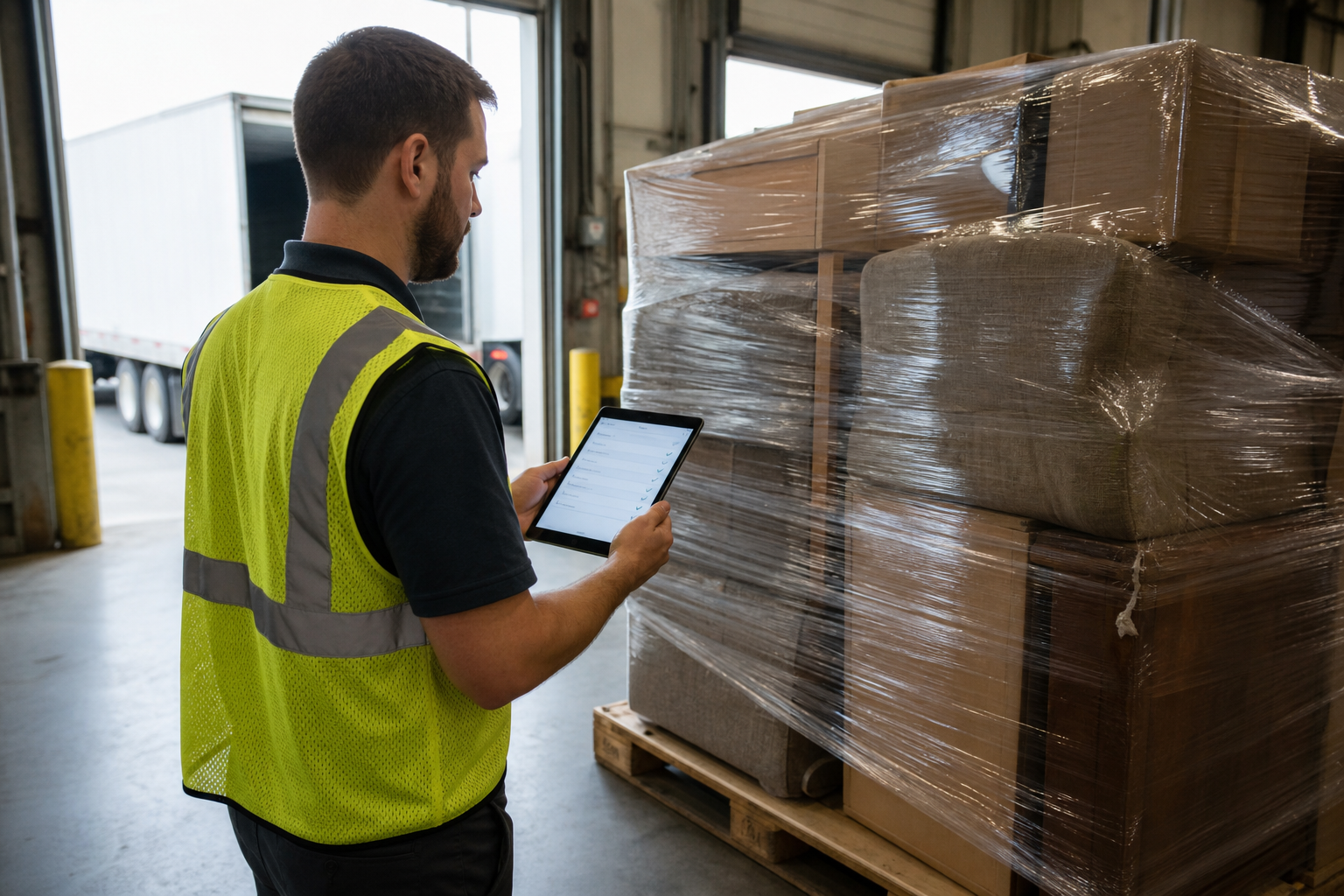
Piece counts checked before the pallet ever leaves the dock make the delivery-end documentation easier to trust.
How DirectXpress builds proof of delivery into every stop
DirectXpress treats proof of delivery as part of the delivery, not paperwork tacked on afterward. The DirectXpress platform attaches photos, signatures and delivery notes to the order automatically, and pickup confirmation and pallet counts are captured at origin on the same record. Exception alerts and a clear exception and reschedule process sit on that same order, so an issue such as a scuffed box corner or a changed drop location does not depend on a phone call days later.
This documentation gets attached to the shipment record automatically, so when a claim does come in, the shipper isn't waiting on a driver's memory or digging through paper logs. The photos, signature and delivery notes are already there, dated and tied to the exact delivery, alongside the pallet count captured at origin. For shippers moving heavy or high-value freight, that record gives a claim a factual starting point instead of an argument over what happened at the door.
If proof of delivery gaps have been costing time or money on your deliveries, it's worth a look at how your current provider documents each stop. You can review DirectXpress's final mile delivery service to see how documentation is built into residential and commercial delivery from pickup to final placement.
A quick checklist for shippers auditing their own POD process
A thin proof of delivery process can go unnoticed until a dispute forces someone to pull the file. Before that happens, it's worth running a quick internal audit against a short checklist:
- Timestamped photos: Does every delivery generate a photo of the item in place, not just a photo of a signature screen?
- Piece counts: Is the delivered count checked against the original bill of lading or purchase order, especially on multi-box furniture orders?
- Named signer: Is the signature tied to a specific person and delivery address, rather than an unnamed "customer" field?
- Exception logging: Are drivers trained and required to note damage, shortages, or placement changes at the time of delivery, not after a complaint?
- Accessible records: Can a claims team pull the full proof of delivery packet for any stop within minutes, or does it take a phone call to the driver?
If the answer to two or more of these is no, those are the gaps to close before the next dispute. The fix isn't complicated. It's a matter of requiring the same four data points, photo, count, signature, and exceptions, on every single stop, and making sure that record is stored somewhere a claims team can reach it without chasing anyone down.
FAQ: Proof of delivery
What counts as valid proof of delivery for freight shipments?
Valid proof of delivery for freight includes a timestamped photo of the item at its final placement, a signature from an authorized recipient tied to the specific address and time, a piece count checked against the bill of lading, and a note of any exceptions like damage or a changed drop location. A signature alone confirms receipt, not condition or completeness.
Who is responsible for proving damage happened before delivery versus after?
That depends on the applicable terms, the law and the evidence, and no single document guarantees the outcome for either side. A timestamped photo showing the item intact at delivery is strong evidence of its condition at handoff; without one, the carrier has less to show if a customer disputes the condition.
How long should proof of delivery records be kept?
Check the terms that apply to the shipment. The claim filing deadline is set by the carrier's terms; for claims covered by federal law (49 U.S.C. 14706), a carrier may not allow less than nine months to file a claim, or less than two years to bring a lawsuit after it denies one. Record retention is a separate decision: keep proof of delivery records at least as long as a claim or lawsuit over the shipment could still be brought.
Does proof of delivery matter more for residential deliveries than commercial ones?
In some ways, yes. Commercial deliveries may have a receiving clerk who checks freight against a manifest before it's accepted. Residential deliveries may not have that second set of eyes, so the driver's documentation can be the only record of condition and count at the time of handoff.
What should a shipper do if a proof of delivery record is missing key details?
Flag it immediately with the carrier and ask for the delivery to be re-documented if the driver is still on route, or request any available secondary evidence like GPS timestamps or dispatch notes. Going forward, the fix is requiring photo, count, signature, and exception logging as a standard part of every delivery, not an optional step left to driver discretion.
About the author
DirectXpress Dispatch
Dispatch and Operations, DirectXpress
The dispatch team at DirectXpress, an Ontario, CA freight company holding both broker and motor carrier authority (MC 1801477 / USDOT 4539992). Same-day LA County freight, heavy final mile for 150-1,500 lb shipments, and nationwide LTL.