
What Is a Liftgate? Truck Liftgate Types and Limits
What a truck liftgate is, the main types, typical capacity and platform sizes, and how to check your pallet against the gate before you book.
Short answer: A liftgate is a powered platform on the back of a truck that raises and lowers freight between the truck floor and the ground. Typical box truck gates are rated from about 1,250 to 3,000 lb, with a standard platform around 80 by 60 inches, and rail gates run bigger. Before you book, check your pallet's weight and footprint against the gate's rating and platform, not just the truck's size.
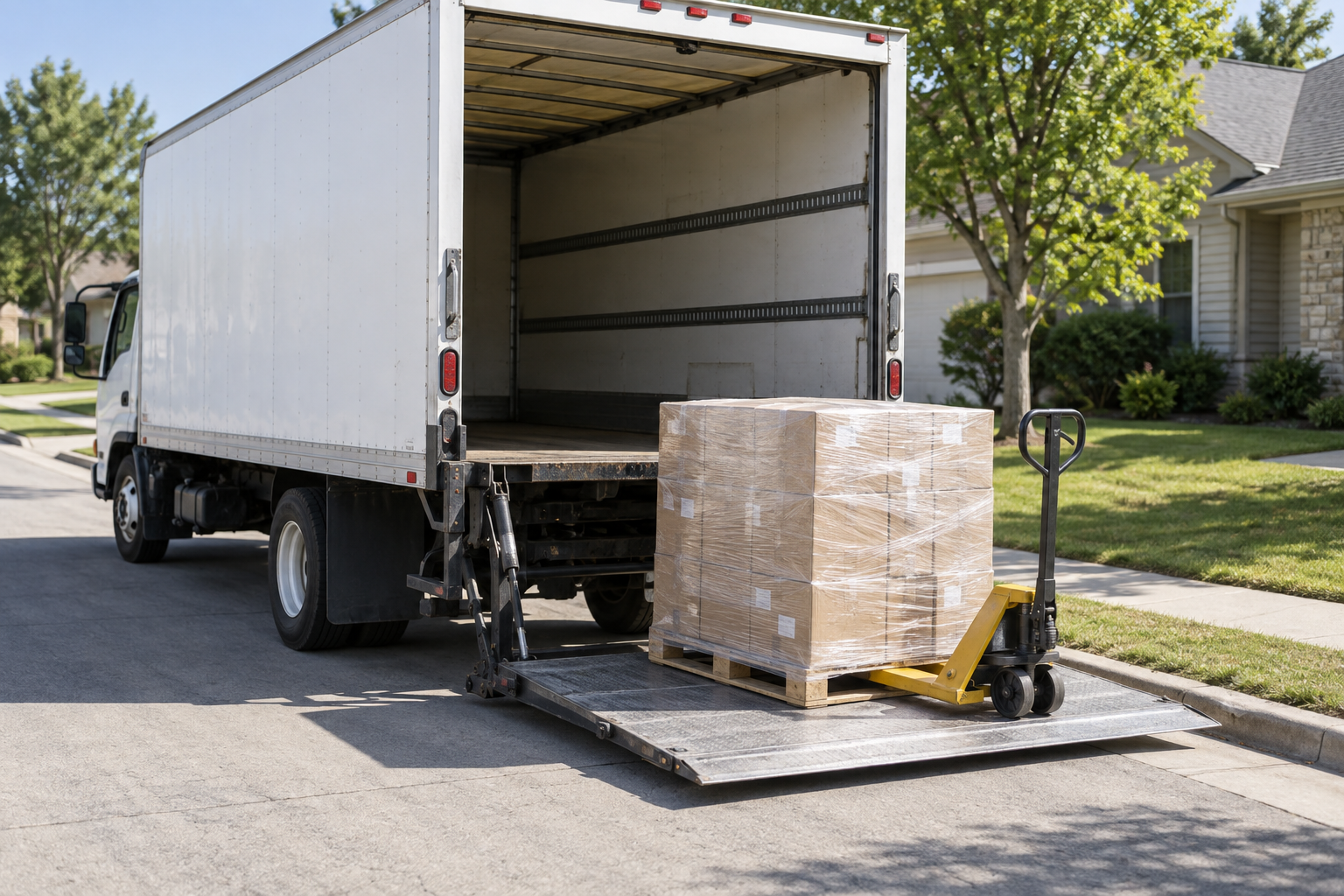
If a pallet is going to a house, a storefront or a job site with no dock, the truck's floor sits roughly four feet off the ground and somebody has to bridge that gap. The gate's rating and platform decide whether your freight can make the trip down safely. This guide covers the main liftgate types, the weight ranges you'll see, the platform sizes that matter for pallets, and how to check your own freight before you book.
What a liftgate is and how it works
A liftgate is a hydraulic or electric platform mounted at the back of a truck. It sits level with the truck floor, lowers to the ground with the freight on it, and lifts the next piece back up. With a pallet jack aboard, a driver can then move a pallet between the truck and the curb without a dock or a forklift.
For guidance on when a shipment needs one, see our liftgate delivery service page.
The main liftgate types
Box truck liftgates mostly fall into a few families. The names vary by manufacturer, but the differences that matter to a shipper are where the platform stores, how much platform depth you get, and how heavy a load it's built for.
Tuck-under (tuckaway) gates
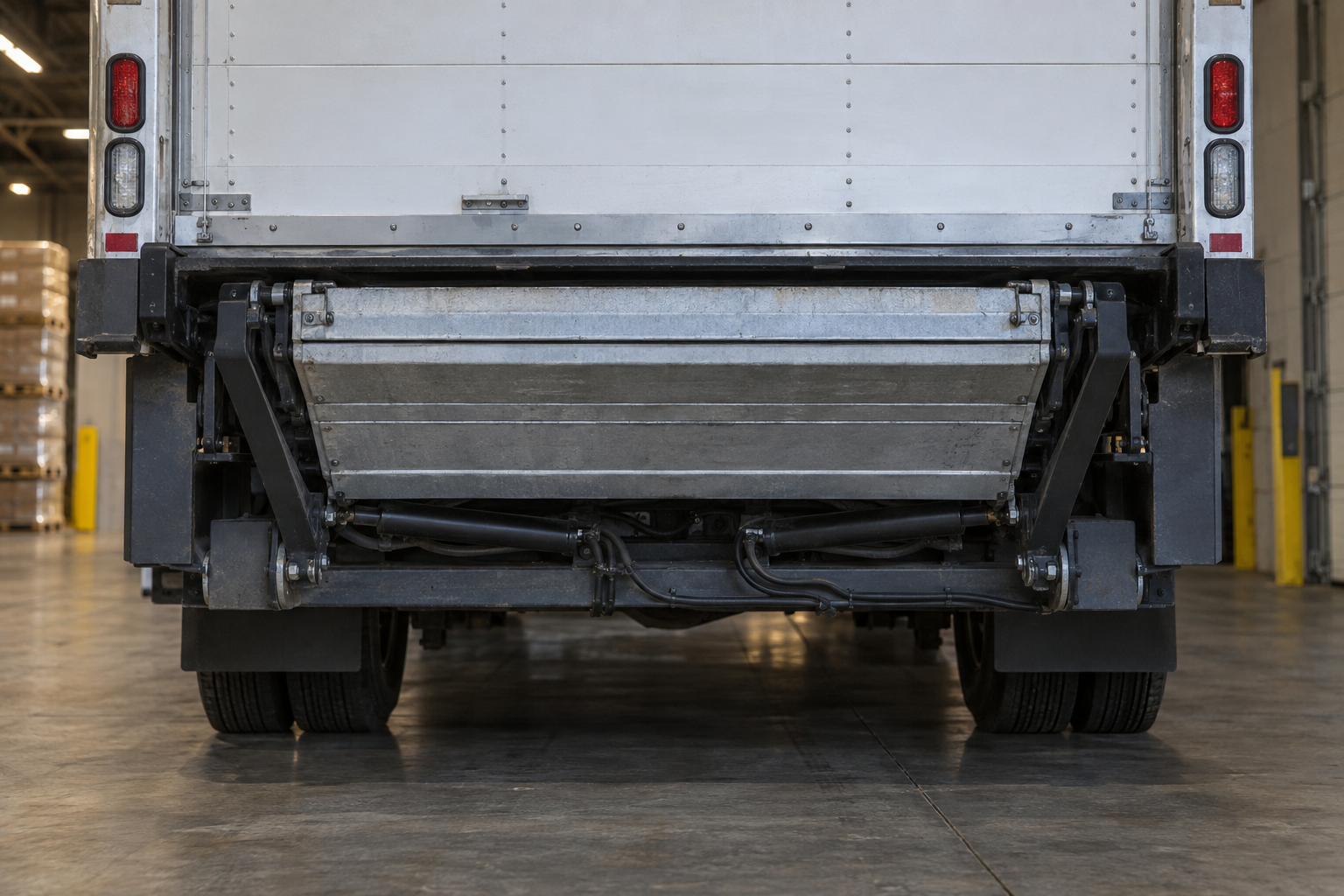
The platform folds and slides underneath the truck body when it's not in use, so the rear doors stay clear. They're common on medium-duty box trucks and are the style Enterprise Truck Rental lists on its 26 ft box truck. One manufacturer, Tommy Gate, lists tuck-under models rated at 2,500 and 3,000 lb. The tradeoff, according to liftgate maker Anjer, is that a tuck-under may not offer as much platform depth as a cantilever or rail gate, and it needs careful measurement against the truck chassis.
Cantilever gates
Cantilever gates also store under the body and are commonly paired with the same class of truck. Niuli Auto's guide to truck lift gates says Class 3 to 5 medium-duty box trucks typically pair well with tuck-under or cantilever gates in the 1,500 to 3,500 lb range.
Rail gates
Rail gates mount directly to the rear frame, and the platform typically stows upright against the rear doors rather than under the body. According to a 2025 box truck liftgate guide from The Upfit Insider, rail gates run bigger than the standard platform size. The tradeoff is that the stowed gate sits across the back of the truck, so it has to be raised and opened out of the way to use the doors.
Power source
Hydraulic is the standard power setup for box truck gates, and electric is the lighter-duty option, per the same guide. For freight shipping, assume a hydraulic gate unless your carrier says otherwise.
Liftgate weight limits: what the ratings mean
Box truck liftgates are sold in capacity ratings from about 1,250 to 3,000 lb, according to The Upfit Insider's guide, and manufacturers like Tommy Gate list tuck-under models at 2,500 and 3,000 lb. The right number for you is the rating on the specific truck that shows up, which is why a vague "liftgate" on a booking isn't enough information.
Three things to keep in mind when you compare your freight to a rating:
- Count everything on the platform. The weight is the pallet or crate plus any packaging, plus the pallet jack if it rides up with the load. Weigh the finished pallet instead of estimating. Our palletizing guide explains why a 700 lb machine on a skid needs to be one solid unit before it ever reaches the gate.
- Rated capacity isn't the same as truck payload. A 26 ft box truck can carry thousands of pounds in total (Enterprise lists up to 10,000 lb payload on one model), but the gate lifts only what its own rating allows, one platform at a time.
- Placement matters. Capacity ratings assume the load sits on the platform the way the manufacturer intends. A tall, top-heavy or off-center load can be unsafe well under the number on the plate. If you aren't sure, ask the carrier what the gate on the assigned truck is rated for and how it wants the freight positioned.
If your freight is heavier than any gate rating, a gate truck isn't the answer. You'd need a forklift at the site, a dock, or a rigging company. Our post on moving heavy machinery covers that situation.
Liftgate platform sizes and what fits on them
The standard box truck liftgate platform is about 80 inches wide by 60 inches deep, according to The Upfit Insider's guide, with rail gates running bigger. Tuck-under gates can be shallower, as Anjer notes, so the platform you actually get depends on the gate style and the truck it's bolted to. Treat 80 by 60 as a typical figure to plan around, not a promise for any given truck.
Here's how a common footprint lines up against that typical platform. The 48 by 40 inch GMA pallet is the North American standard (our standard pallet sizes reference covers the others):
| Freight | Footprint | Fits a typical 80 x 60 in. platform? |
|---|---|---|
| One 48x40 pallet | 48 x 40 in. | Yes, with room to spare |
| Two 48x40 pallets side by side | 80 x 48 in. | Yes on paper, but check the weight against the gate rating first |
| Oversize crate, 60 x 48 in. | 60 x 48 in. | Fits, but confirm the gate depth and height clearance |
| Anything wider than 80 in. | 80+ in. | No, plan other equipment |
Footprint is only half of it. Height matters because the load rides up and down on an open platform and then has to roll into the truck through the rear door opening. A tall pallet can clear the platform and still be a problem at the doorway, so give your carrier the full height, not just length and width. Freight that's top-heavy or unstable should be fixed at the pallet stage, and our palletizing guide covers how.
For our own runs, DirectXpress's 26 ft box trucks carry up to roughly 12 pallets with liftgate access, with a pallet jack aboard. For a specific shipment, the gate rating and platform on the assigned truck are the facts to confirm.
How to check your freight against the gate before you book
Five minutes of measuring before you request a quote prevents most failed liftgate deliveries. Work through this list:
- Weigh the finished pallet. Include the pallet, packaging and any strapping. If it's near 1,250 lb or higher, tell the carrier up front, since that's already at the low end of common gate ratings.
- Measure length, width and height after wrapping. These are the same numbers a carrier uses for density, and our guide to LTL freight class shows how they feed pricing.
- Check the doorway and the ground at the delivery address. A gate needs level, firm ground at the curb. Steep driveways, soft dirt, stairs or gravel can stop a delivery even when the gate is rated for the weight.
- Count the pieces. Several pallets mean several trips on the platform, and the driver needs to know the total so the truck and the time window fit.
- Say what's at the other end. If the receiver has a forklift or a dock, tell us, because it can change whether a gate is needed at all.
Then send those details with the full pickup and delivery addresses through the quote form. If the freight is borderline for a gate, we'd rather tell you what to change before pickup day than at the curb.
For liftgate delivery pricing, see our liftgate delivery service page.
FAQ: Liftgate types and limits
How much weight can a liftgate lift?
Box truck liftgates are commonly rated from about 1,250 to 3,000 lb, per The Upfit Insider, and Tommy Gate lists some tuck-under models at 2,500 and 3,000 lb. The rating on the specific truck is the number that counts, so ask your carrier what the assigned gate is rated for.
What size is a standard liftgate platform?
A typical box truck platform is around 80 by 60 inches, and rail gates can be larger. Tuck-under gates can have less platform depth. A standard 48 by 40 inch pallet fits easily, and two such pallets side by side measure 80 by 48 inches.
What are the main types of truck liftgates?
The common ones on box trucks are tuck-under (tuckaway), cantilever and rail gates. Tuck-under and cantilever gates store beneath the body, while rail gates mount to the rear frame and typically stow upright at the back of the truck. Most are hydraulic.
What if my freight is heavier than the liftgate rating?
Don't try it. Exceeding a gate's rating is unsafe, and carriers can refuse it. Plan for a forklift or crane at the site, a dock, or specialized rigging, and tell the carrier the true weight when you ask for a quote.
About the author
DirectXpress Dispatch
Dispatch and Operations, DirectXpress
The dispatch team at DirectXpress, an Ontario, CA freight company holding both broker and motor carrier authority (MC 1801477 / USDOT 4539992). Same-day LA County freight, heavy final mile for 150-1,500 lb shipments, and nationwide LTL.